The USS Prometheus
By Larry White
In Greek mythology, Prometheus a Titan and brother of Epimetheus and Atlas, who stole a spark from heaven and gave it as a gift of fire to newly-created mankind. To punish him for this act, Zeus (Jupiter) chained him to a rock in the Caucasus, where an eagle daily tore at his liver. Each night Prometheus regenerated his damaged liver, until finally he was delivered from his torment by Hercules
| 
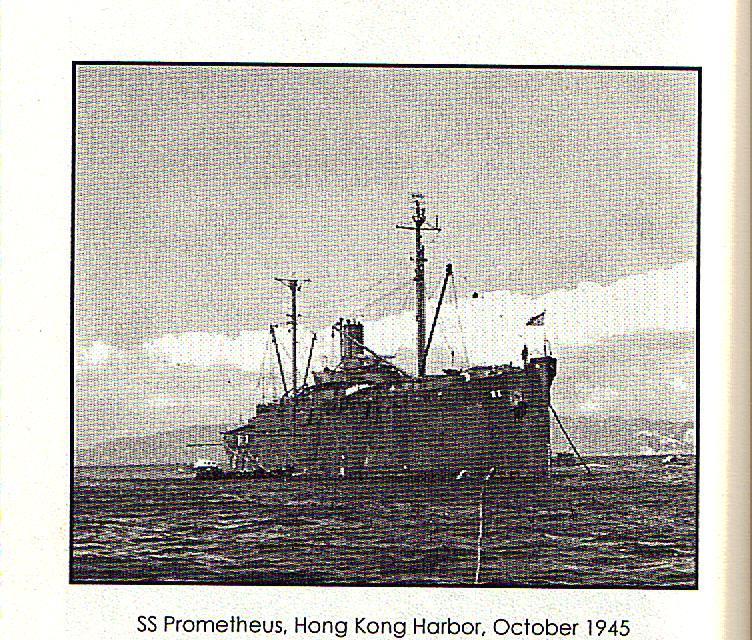
Propulsion two New York Navy Yard vertical triple-expansion reciprocating steam engine three White-Forester boilers, 200psi, °Sat (coal fired boilers, converted to oil) three turbo-drive 300Kw 120V/240V D.C. Ship's Service Generators two propellers, 7,500shp In a similar way to the hospital ships, who treated damaged people far from normal facilities, repair ships were built to maintain equipment away from the normal heavy repair facilities. Aircraft in particular require frequent heavy maintenance to ensure their continued operation. As the island-hopping campaign moved closer to <?Japan, and further from established bases, the repair ships moved with the forward fields. The armament provided varied considerably, and could include four inch and three inch guns, 20mm and 37mm cannon, as well as 0.3 and 0.5 inch machineguns. The largest gun (generally a four inch) would typically be fitted at the stern, and would be flanked by two smaller guns (such as two single 20 mm cannon). There would usually be four gun positions on the superstructure, and these could be 20mm cannons, machineguns, or a mixture of both. The forward mast would be provided with two guns, usually 20mm cannon or 0.5 inch machineguns. On the bow would often be a single three inch gun. Many variants on this typical arrangement existed, with additional guns being fitted in other areas (such as two or four guns added adjacent to the second mast), or the arrangements changed from those described above (such as replacing the single bow gun with two 37mm cannon).
|
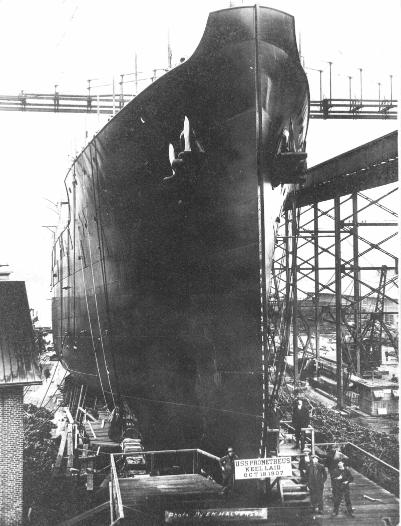
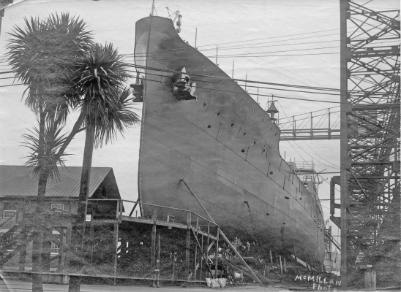
The USS Ontario fleet collier number 2's keel was laid down October 18 1907. as was her sister ship the USS Erie which became the USS Vestal that was beside the USS Arizona at the time of the attack on Pearl Harbor. The
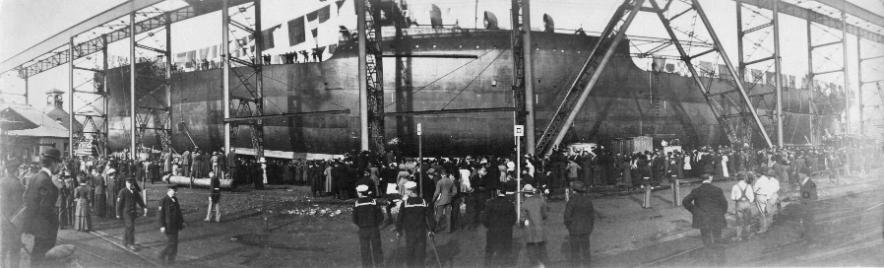
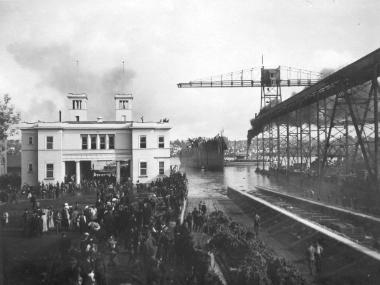
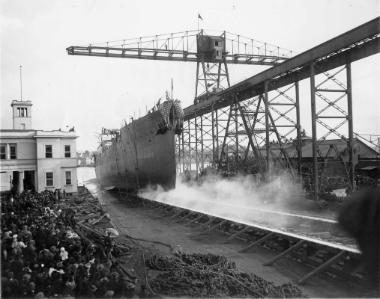
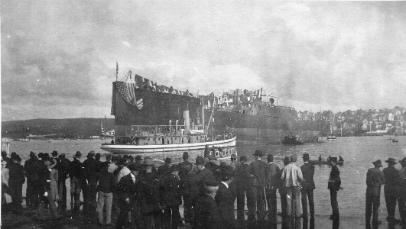
The USS Ontario was initially launched December 5th, 1908. On January 15th 1910 the ship was commissioned as the USS Ontario and placed in the Naval fleet to begin her career
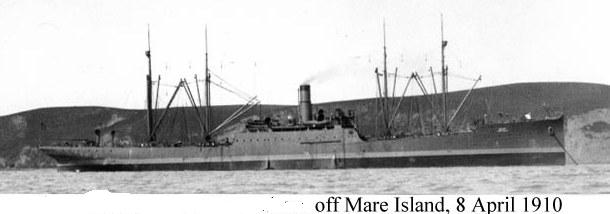
The career of the Ontario was very short lived as she served with a merchant complement until she was decommissioned April 17th, 1913 to undergo conversion to become a fleet repair ship. After the conversion into a repair ship she was recommisioned December 23rd, 1914 as the USS Prometheus repair ship number 2.
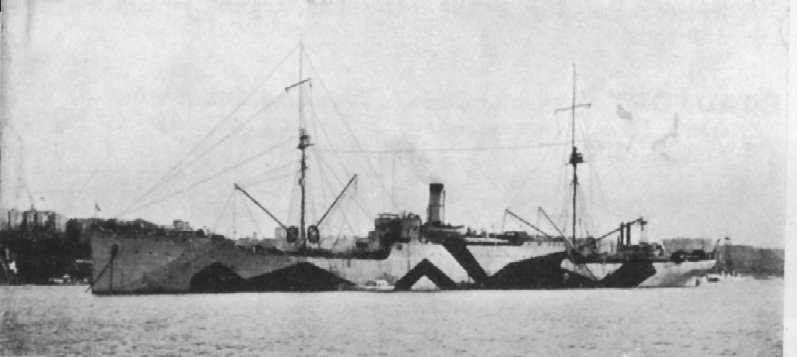
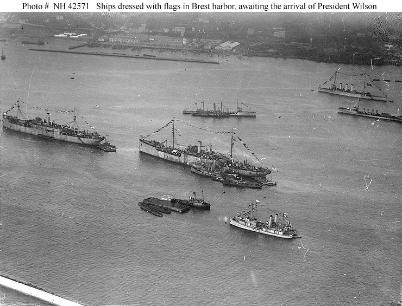
After completion she was sent to cruise the Alaskan waters until 1915 when She was assigned to duty with the Atlantic fleet May 16th 1916 operating out of <?Norfolk Virginia for Bermuda remaining there until January 29th 1918. While in Bermuda she was ordered to Brest France to repair ships damaged in World War 1 and for the visiting of President Wilson to France.
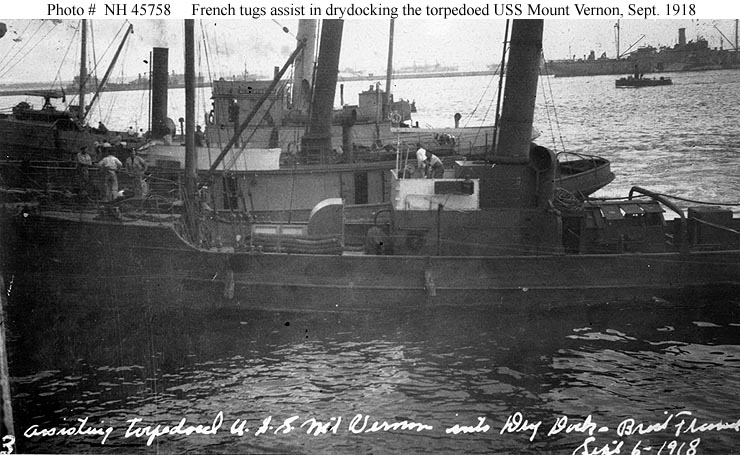
USS Mount Vernon French tugs assist the ship into dry dock at Brest, France, on September, 6th 1918. She had been torpedoed on the previous day by German submarine U-82. USS Prometheus is on the right in distance, with U.S. Navy destroyers alongside
The USS Prometheus did a commendable job repairing ships damaged until she sailed for New York January 16th 1919. Upon arrival at New York she was assigned to Battleship Force 1 for duty in conjunction with the upkeep of vessels engaged in overseas transportation of troops. She was classified as AR–3, July, 17th 1920 |
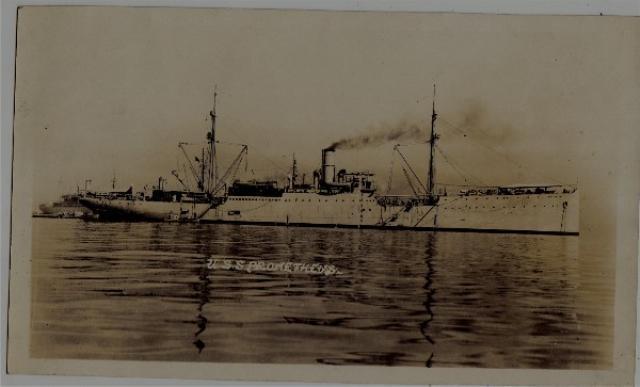

The USS Prometheus was sent September 1st 1920 to Guantanamo Bay Cuba to tow the disabled USS Connecticut (BB-18), to Philadelphia.
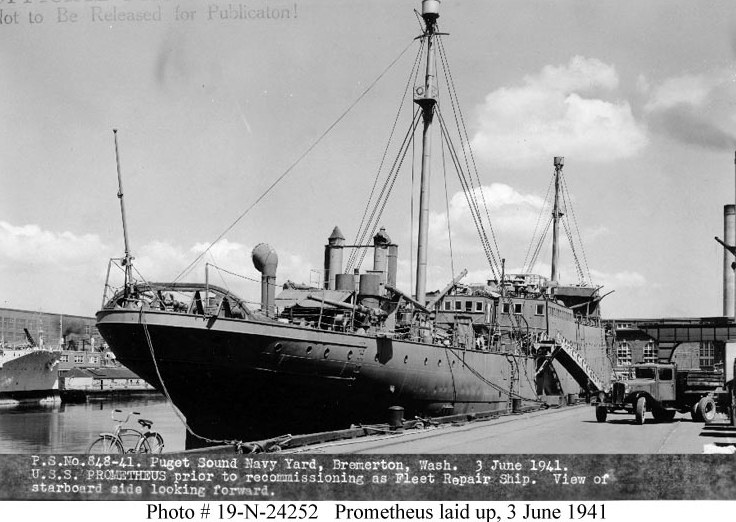
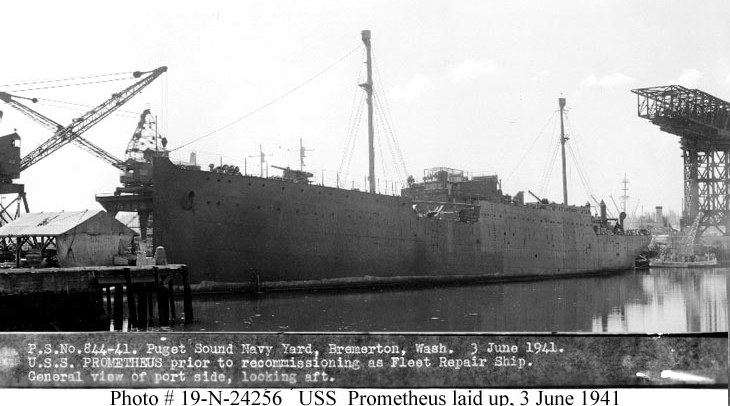
For her performance in this assignment she was commended by the Commander-in-Chief, Atlantic Fleet. Prometheus made additional cruises to Cuba in 1921 and 1923 while operating with the Atlantic Fleet. The USS Prometheus transferred to the west coast early in 1923, arriving at San Pedro,By 1941 the United States was well on its way of preparing for war and was in the midst of rebuilding its naval fleet. The USS Prometheus was located in the Puget Sound Navy Yard in Bremerton
  |  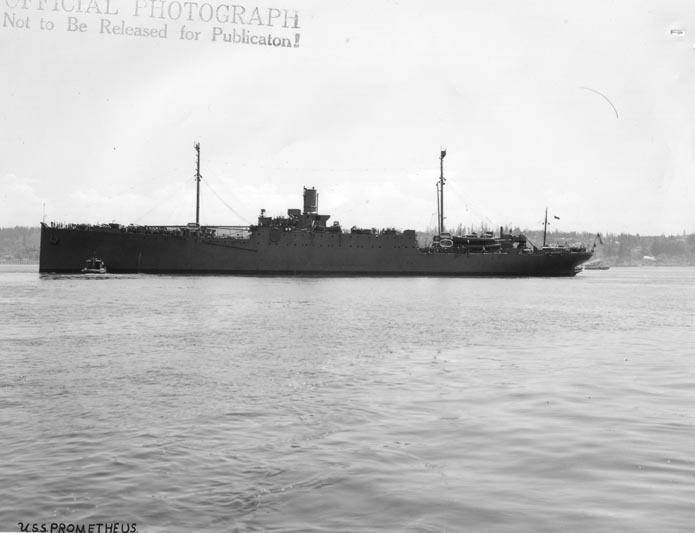 |
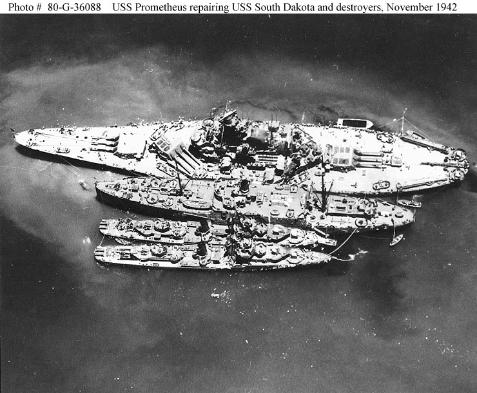
After refitting her the USS Prometheus was recommisioned on May 15th, 1942. The picture above is of her leaving Puget Sound Navy Yard in Bremerton Washington on her shakedown run to San Francisco after leaving San Francisco the ship went directly to Pearl Harbor in Hawaii to pick up ARD3 floating Dry-dock as they were towing the ARD3 dry-dock to Australia with several other ships along for overall protection they ran into a large radar report from several Japanese ships in a convoy and when the Japanese saw the size of the radar report they were getting the assumed it was an aircraft carrier and support vessels so they hightailed it out of the area so they would get destroyed this was a lucky call for the Prometheus and the others as they did not have the defenses to deal with a battle on the sea.
 |  |